
Generator types
Gas Generator Repairs, Servicing and Maintenance
Gas generators run on LPG or natural gas through a spark-ignited engine, so they need ignition, valve-clearance and gas-pressure care rather than the fuel-filter work a diesel needs. We repair and service the engine, ignition, controls, alternator and changeover of gas generators on site in Gauteng, from home standby units to commercial sets. Work on the gas supply itself is done by a registered gas installer.
Established 2006
20 years of experience
24/7 operations
We Arrive Within 1–2 Hours
(usually within 1 hour)
Free callouts and quotations
One-year warranty
Qualified and certified technicians
We Service & Repair All Generator Brands
All generator makes and models
1 kVA–20,000 kVA capability
LPG or natural gas?
Most gas generators at Gauteng homes run on LPG, stored as a liquid under pressure in a bank of large cylinders or a bulk tank. The engine draws the vapour that boils off the liquid, so cylinder size and number matter: a cold or nearly empty cylinder cannot make vapour fast enough for a heavy load.
Natural gas arrives by pipe, so there is nothing to refill, but it reaches only some parts of Gauteng. It carries less energy per cubic metre than LPG, so it needs a bigger flow and pipe, and many sets are rated a little lower on it; the manual gives both figures.
Either way, the fuel does not go stale, collect water or grow diesel bug, and it burns cleanly, without the wet stacking a lightly loaded diesel suffers. The trade-off is a supply that must be sized for full load: if the pressure sags when a big load starts, the set falters just when it is needed.
Diesel, petrol and gas generators compared
| Feature | Diesel | Petrol | Gas |
|---|---|---|---|
| Ignition | DieselCompression, no spark plugs | PetrolSpark plug and coil | GasSpark plugs and coils |
| Fuel on site | DieselA tank that ages and collects water | PetrolA small tank; goes stale in months | GasCylinders, a bulk tank or a pipe; keeps indefinitely |
| Typical sizes | DieselSmall silent sets to industrial plants | PetrolAbout 1–10 kVA, portable or open-frame | GasHome standby units to commercial sets |
| Main service needs | DieselFuel filters, water draining, running under load | PetrolFresh fuel, carburettor care, oil checks | GasPlugs, valve clearances, the right oil, supply pressure |
| Weak points | DieselBad fuel, wet stacking, batteries | PetrolStale fuel, low oil, starters | GasPressure under load, cold cylinders, ignition wear |
More on diesel generators and petrol generators. Diesel and gas sets are both widely used as automatic standby generators.
How gas gets from the cylinder to the engine
- 01
Storage or meter
Cylinders, a bulk tank or a gas meter, big enough for the set’s gas use at full load.
- 02
Regulators and pipe
Regulators drop the pressure in stages. A gauge at the generator shows whether it holds under load.
- 03
Shut-off valve
A solenoid valve opens only when the controller calls for fuel, and closes when the set stops.
- 04
Regulator and mixer
A final regulator feeds gas as the engine draws air, and the mixer meters it into the intake.
- 05
Ignition and governor
Plugs fired by coils or an ignition module light the mixture, and a governor holds 50 Hz as load changes.
Gas home standby generators
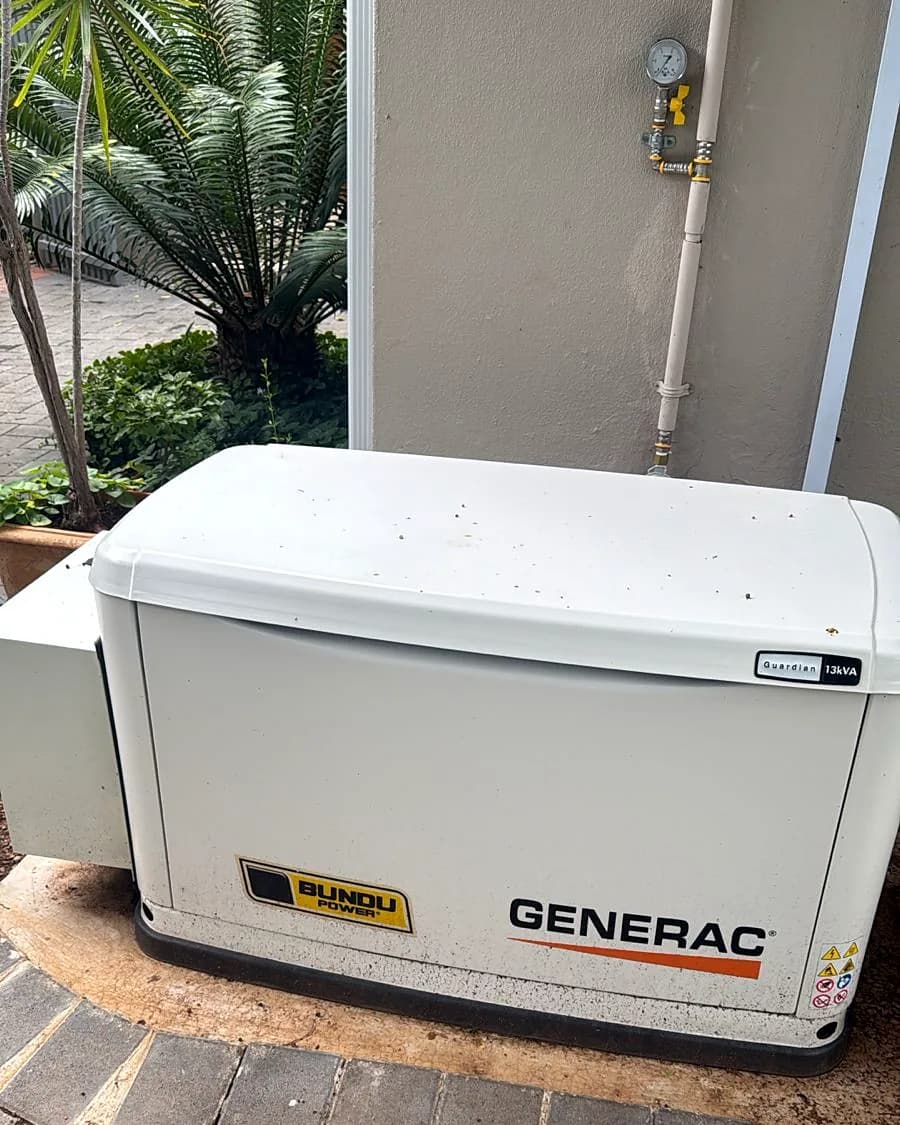
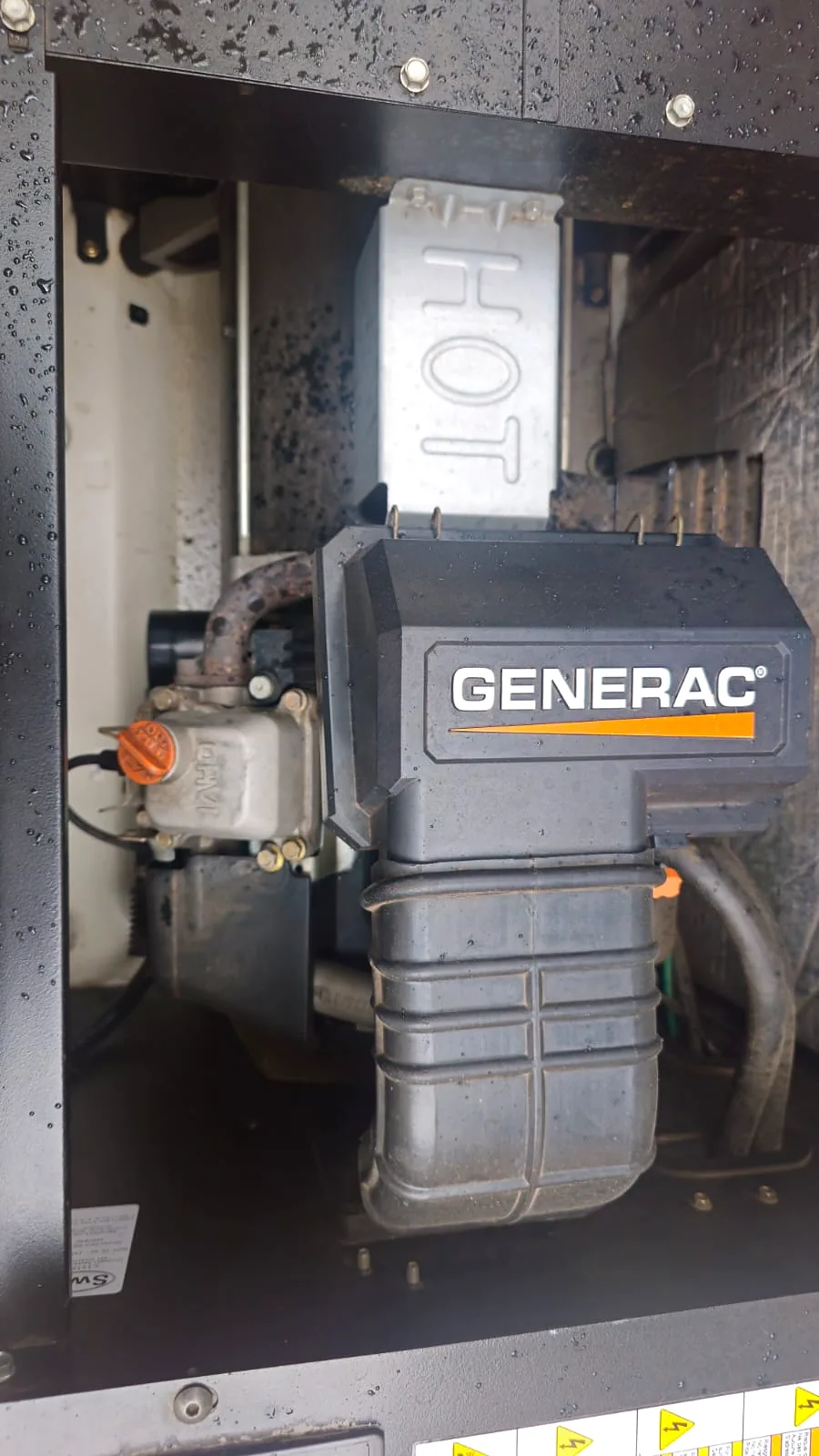
At homes, a gas generator is usually a packaged standby unit, such as a Generac, against an outside wall with its gas line and pressure gauge beside it. Inside are an engine, air-cooled on most home units, an alternator and a controller; a separate transfer switch, usually beside the distribution board, moves the house onto the generator when the mains fails.
They start themselves for a short exercise run on a timer, so faults usually show first as an alarm on the display. Air-cooled engines run hot, so oil, valve clearances, plugs and the air filter matter more than on a liquid-cooled set. More on standby generators and on running a home through load shedding in home generator services.
- Oil and filter, plugs, air filter and valve clearances
- Battery and built-in charger tested
- Transfer switch tested with the house on load
Servicing and repairing a gas generator
Ignition system: Generator not starting
Spark plugs, leads, coils and ignition modules. Worn plugs and weak sparks cause misfiring, hard starting and power loss under load.
Valves and oil: Service intervals and oil care
Gas burns hot and dry, so valve clearances need checking. Use the oil the maker specifies; larger gas engines need a gas-engine oil.
Gas train on the generator
We check that the shut-off valve opens and closes with the controller, and note the supply gauge reading at rest and under load. Any work that opens the gas line is for a registered gas installer.
Controller, alternator and changeover: Control panel repairs
The same controller, AVR, alternator and changeover work as on any standby set.
Gas generator problems
| Symptom | Likely causes | Repair route |
|---|---|---|
| Cranks but will not start | Likely causesGas closed or cylinders empty, shut-off valve not opening, no spark | Repair routeGenerator not starting |
| Falters or stops when a big load starts | Likely causesSupply pressure drops: pipe or regulator too small, too few cylinders, overload | Repair routeShutting down or tripping |
| Misfires or loses power when hot | Likely causesWorn plugs, failing coil or ignition module, tight valve clearances | Repair routeFrequency and speed problems |
| LPG set struggles on cold mornings | Likely causesCold or nearly empty cylinders cannot vaporise gas fast enough | Repair routeGenerator not starting |
| Did not start when the power went off | Likely causesFlat battery, controller not in auto, transfer switch fault | Repair routeChangeover and ATS problems |
Repairs, servicing and maintenance for gas sets
For a fault, book a generator repair: we find the cause on site and quote before work starts. A generator service covers the engine, ignition, battery, controller and a test run, and a maintenance plan adds scheduled visits for sets that protect a business. When you call, tell us the make and model, the gas it runs on and what the display shows.
FAQ
Frequently asked questions
Do you work on the gas supply to my generator?
The gas supply, from the cylinders or meter to the generator connection, must be installed and repaired by a registered gas installer, who issues a Certificate of Conformity for the installation. Our work is the generator itself: engine, ignition, controls, alternator and changeover. If the supply pressure falls short under load, we show you the readings so the installer can put it right.
Why does my LPG generator struggle in winter?
LPG evaporates more slowly when the cylinder is cold or nearly empty, so under a heavy load the supply can fall short. Your gas supplier can advise on cylinder size and arrangement.
How long will my gas cylinders run the generator?
It depends on the load: gas use rises as the load increases, so the same cylinders last longer when the set is lightly loaded. The manual gives consumption at different loads, and at a service we can tell you how heavily your set is loaded.
Is a gas generator cheaper to maintain than a diesel?
It avoids diesel fuel problems such as water, sludge and wet stacking, but adds ignition parts that wear. Overall costs depend on the engine, its hours and how it is used.
Related pages
Related generator problems
Generator types
Related brands
Who we work for
Need a generator technician?
- 24/7 operations
- We Arrive Within 1–2 Hours (usually within 1 hour)
- Free callouts and quotations