
Generator repairs
On-Site Generator Repairs Across Gauteng
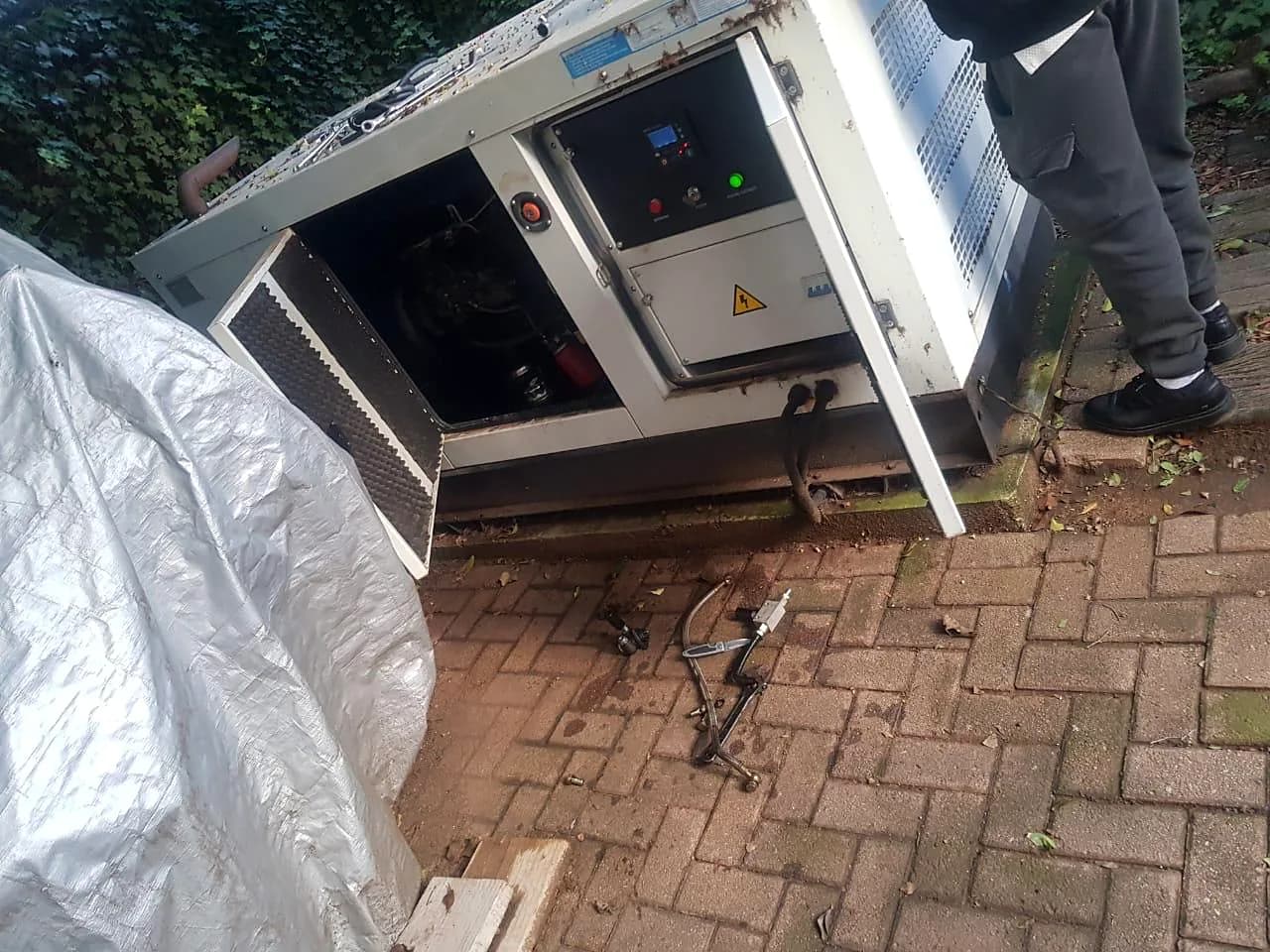
We repair generators on site across Gauteng: diesel, petrol and gas sets of every make, from portable units to large standby generators. A technician finds the fault, mechanical or electrical, and quotes for the repair before any work starts. We normally arrive within 1–2 hours.
- Fault finding on site for diesel, petrol and gas generators
- Mechanical and electrical repairs: engine, fuel, cooling, alternator, AVR, controls and changeover
- All generator makes and models, 1 kVA–20,000 kVA
- Free callouts and quotations; one-year warranty
Established 2006
20 years of experience
24/7 operations
We Arrive Within 1–2 Hours
(usually within 1 hour)
Free callouts and quotations
One-year warranty
Qualified and certified technicians
We Service & Repair All Generator Brands
All generator makes and models
1 kVA–20,000 kVA capability
What is your generator doing?
| Symptom | Likely causes | Repair route |
|---|---|---|
| Nothing happens, or it only clicks | Likely causesFlat or failed battery, corroded terminals, emergency stop engaged, starter solenoid or start relay | Repair routeGenerator not starting |
| Cranks but will not fire | Likely causesNo fuel or air in the fuel system, blocked filters, fuel shut-off solenoid, worn injection components | Repair routeGenerator not starting |
| Did not start on its own when the power went off | Likely causesWeak battery or failed battery charger, controller left in manual or off, a mains-sensing or auto-start wiring fault | Repair routeChangeover and ATS problems |
| Runs, but no power at the sockets or board | Likely causesTripped output breaker, AVR or excitation fault, loss of residual magnetism, wiring or changeover fault | Repair routeRunning but no power |
| Lights flicker or voltage swings | Likely causesAVR fault, sensing wiring, unstable engine speed, overload or unbalanced load | Repair routeVoltage problems |
| Engine hunts, surges or the frequency is wrong | Likely causesGovernor or actuator fault, speed pickup, fuel starvation, a load the set cannot hold steady | Repair routeFrequency and speed problems |
| High temperature alarm or shutdown | Likely causesLow coolant, blocked radiator, slipping fan belt, failed thermostat or water pump, poor ventilation | Repair routeOverheating |
| Low oil pressure alarm or shutdown | Likely causesLow oil level, a faulty sender or switch, a worn oil pump or bearings, oil thinned by fuel | Repair routeLow oil pressure shutdown |
| Shuts down or trips when load comes on | Likely causesOverload, fuel starvation under load, protection settings, breaker or wiring fault | Repair routeShutting down or tripping |
| Fuel, oil or coolant on the floor | Likely causesHoses, clamps, seals, gaskets, filters or tank fittings | Repair routeLeaks |
| Black, white or blue smoke | Likely causesOverload or air restriction, injection faults, coolant or oil reaching the cylinders | Repair routeSmoke |
Diagnosis
Mechanical or electrical? Finding which half has failed
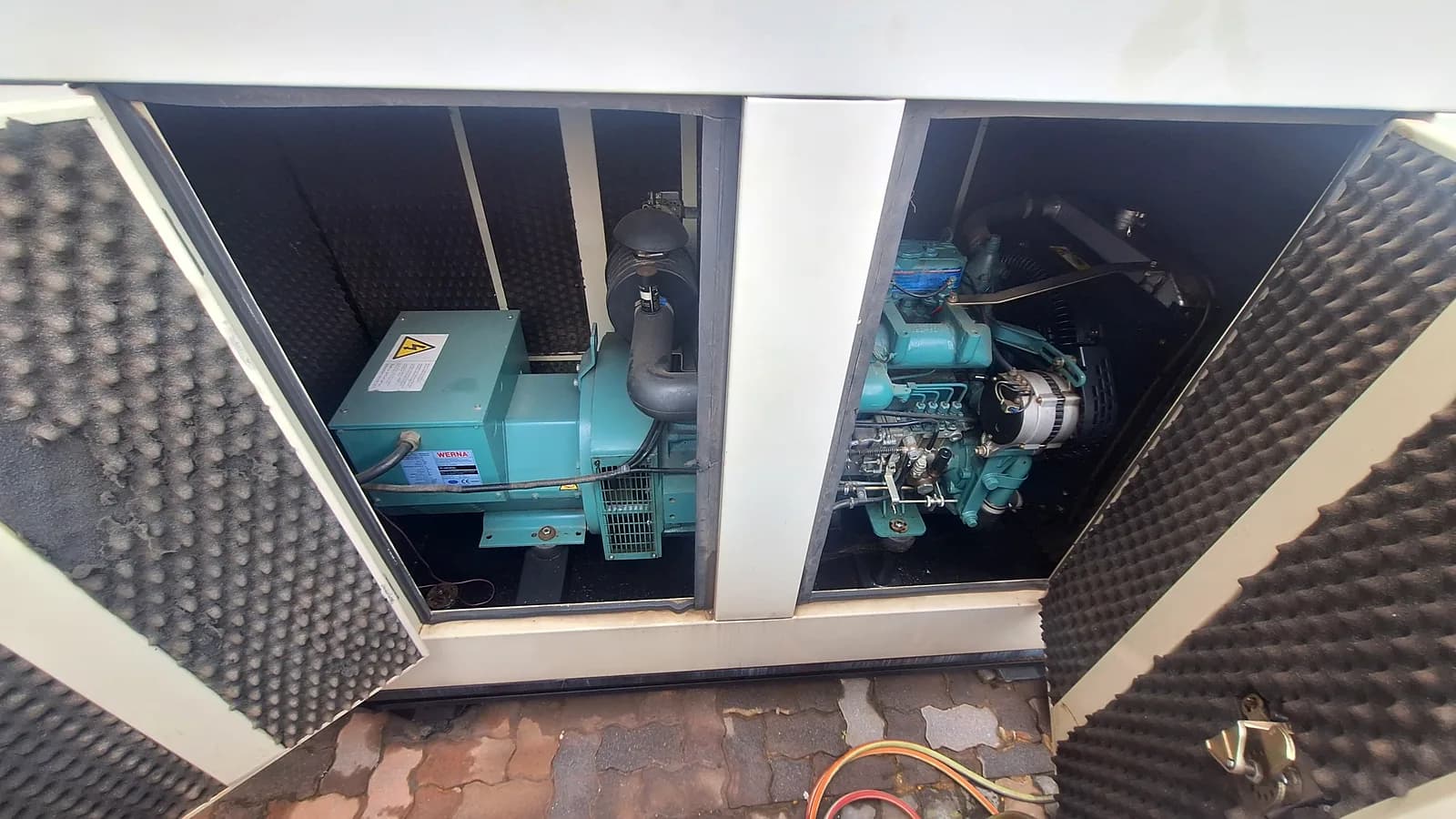
Every generator is two machines joined together. The engine is the mechanical half: it burns fuel and turns the alternator at a fixed speed, 1,500 rpm on a four-pole set or 3,000 rpm on a two-pole set such as most conventional portables, and that speed is what gives 50 Hz. The alternator, its AVR and the controller are the electrical half: they turn the rotation into a steady voltage, protect the set and decide when it starts, stops and takes the load.
Knowing which half has failed is the first step of every repair. A set that cranks but will not fire, overheats, smokes or loses oil pressure points to the engine and its fuel, cooling or lubrication. One that will not crank at all usually has a battery, starter motor or start-circuit fault. One that runs smoothly but gives no output, the wrong voltage, or never takes over from the mains points to the alternator, excitation, wiring or changeover. Speed and frequency faults sit between the two, because the governor is part of the engine but the controller often measures the speed and shuts the set down when it drifts.
Mechanical
Mechanical faults: engine, fuel, cooling and starting
Engine and speed control: Surging and hunting
Mechanical and electronic governors, actuators and speed pickups that hold the engine at the speed that sets 50 Hz, plus turbochargers, valve clearances, compression and engine protection.
Fuel system: Fuel system repairs
Blocked fuel filters, water in the separator, failed lift pumps, air drawn in after the tank runs dry, worn injectors or injection pumps, and fuel shut-off solenoids that will not open.
Cooling system: Overheating
Low coolant, radiators packed with dust and grass, slipping fan belts, failed thermostats and water pumps, perished hoses, and canopies that recirculate their own hot air.
Lubrication and oil pressure: Low oil pressure
Low oil pressure alarms traced to the oil level and grade, a faulty sender or switch, or a real loss of pressure from the pump, relief valve or worn bearings. Oil thinned by fuel is a warning sign we look for.
Starting system: Generator not starting
Batteries and terminals, starter motors and solenoids, start relays, glow plugs on small diesels, and the charge alternator that tops the battery up while the engine runs.
Leaks and exhaust: Leaks
Fuel, oil and coolant leaks from hoses, seals, gaskets and tank fittings, and cracked exhaust manifolds, flexible joints and silencers that leak fumes into an enclosure.
Electrical faults: alternator, controls and changeover
| Part | Typical faults | Read more |
|---|---|---|
| Alternator windings and bearings | Typical faultsLow insulation resistance from damp or dust, windings burnt by overload, worn bearings that let the rotor rub the stator | Read moreGenerator rewinding |
| AVR and excitation | Typical faultsA failed AVR, an open exciter field, failed rotating diodes or loss of residual magnetism, leaving no voltage or a voltage that hunts | Read moreAVR repairs and running but no power |
| Controller | Typical faultsDSE, ComAp or SmartGen modules that will not auto-start, show alarms that will not clear, have wrong or altered settings, or have water or surge damage | Read moreControl panel repairs |
| Sensors and senders | Typical faultsOil pressure, coolant temperature, fuel level and speed sensors that give false readings and can shut down a healthy engine | Read moreShutting down or tripping |
| Wiring, breakers and terminals | Typical faultsLoose or burnt terminations, looms chewed by rodents, output breakers that trip or will not reset, and earth faults | Read moreVoltage problems |
| Changeover and ATS | Typical faultsContactors that stick or chatter, mains-sensing faults, timers set wrongly, and a set that runs but never takes the load | Read moreChangeover and ATS problems |
| Battery charging | Typical faultsFailed mains battery chargers, charge alternators or their regulators, blown fuses, and batteries that never reach full charge | Read moreBattery not charging |
Electrical, control and changeover work needs a technician. On a standby set, wiring can be live from either the mains or the generator even when the engine is stopped, and an automatic set can start without warning.
Load shedding and outages
What load shedding does to a generator
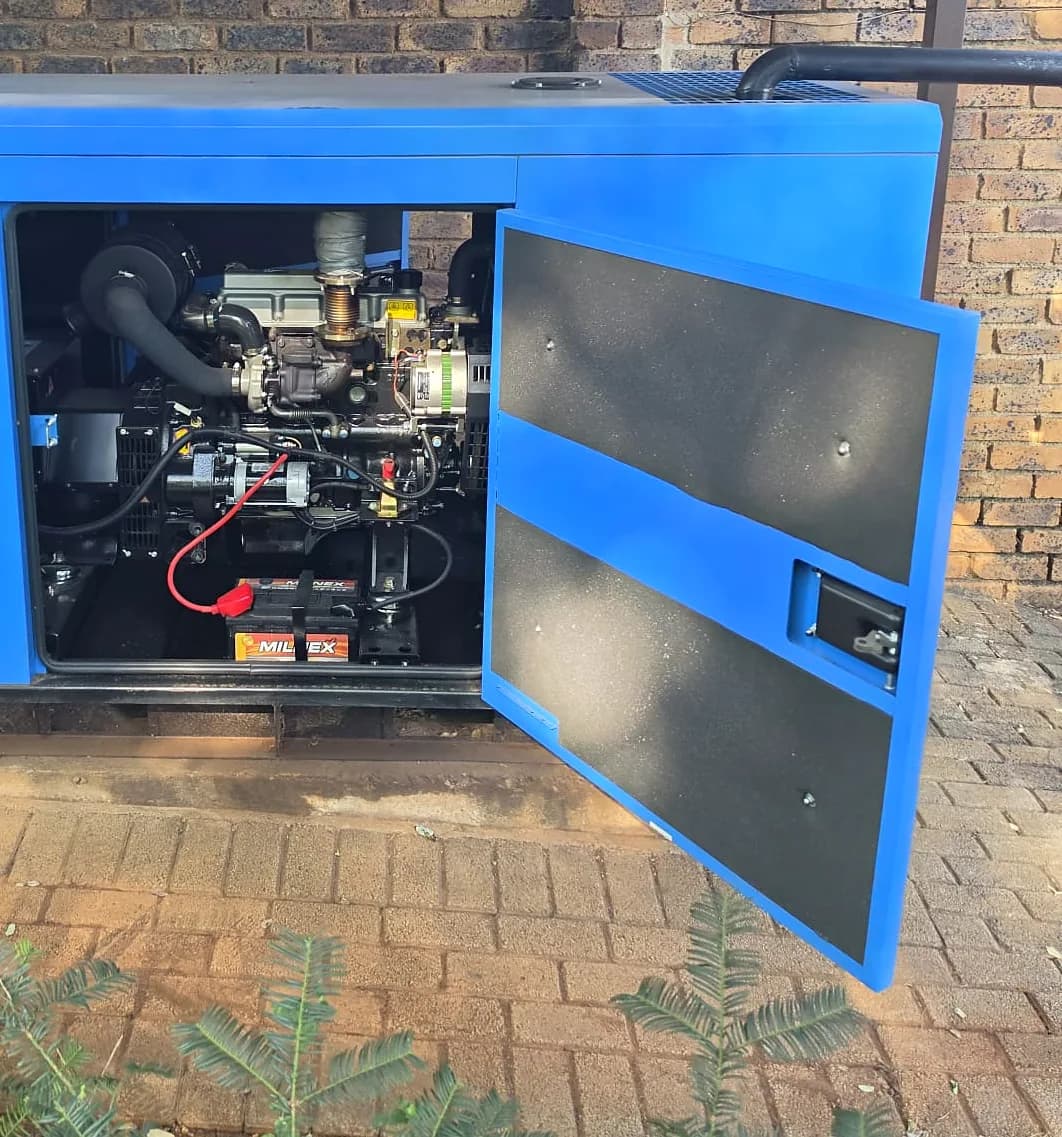
Many standby generators were sized and serviced for the odd outage. Load shedding, municipal faults and back-to-back power cuts change that: several starts a day at higher stages, runs of a few hours, then a changeover back to the mains and a stop. That duty cycle wears particular parts much faster than occasional use does.
The starting battery usually goes first. Every outage takes another start out of it, and the controller draws on it around the clock. Between outages it depends on a mains-powered battery charger to recover; if that charger has failed, or a smaller set has no charger and relies on its charge alternator, short runs may not put back what each start takes out. A weak battery or a failed charger shows up as a set that cranks slowly, or not at all, the moment the power goes.
Changeover panels switch over and back with every outage, so contactors, timers and mains-sensing relays wear sooner, and voltage spikes when the supply returns, or Highveld lightning in summer, can damage chargers and controllers. Running hours climb quickly too: a set that used to run only for tests and the odd outage can reach its hours-based service interval within months, and an overdue service is where many mechanical faults begin. Tanks run low and are topped up from containers that bring in dirt and water, and an oversized diesel set carrying only a light load for hours at a time is prone to wet stacking.
A repair puts the set back in working order. To stop the same faults returning under heavy outage duty, a maintenance plan schedules services by running hours as well as by date, checks the battery and charger between services and proves the changeover.
Process
From your call to a tested repair
- 01
Send us the details
Call or WhatsApp with the make, model and kVA from the rating plate, the fuel type, what happens when you try to start it, and a photo of the controller screen showing any alarm. The hour-meter reading helps too. Our guide to preparing for a technician visit shows where to find each one.
- 02
We come to you
We arrive within 1–2 hours, usually within 1 hour. Have any service records ready, and make sure the technician can reach the generator, its fuel tank and the changeover panel.
- 03
Find the fault
We read the controller’s alarm and event history where it keeps one, test the battery under cranking, check fuel delivery, and measure voltage, frequency and excitation. Where an alternator fault is suspected, the windings are checked as well.
- 04
Explain and quote
We show you what failed, why it failed and what the repair involves, and you decide before any work starts. Free callouts and quotations.
- 05
Repair and prove it
With your go-ahead we repair, then run the set and check voltage and frequency under load where the site allows. On a standby set we also test the changeover both ways: to the generator and back to the mains.
Why on site
Faults are found where the generator lives
A standby generator is part of an installation: a fuel supply, a battery and charger, a changeover panel and the building wiring. A fault can sit in any of them, so it is diagnosed most reliably with the whole system in front of the technician.
Moving a large set is slow and costly, and it separates the generator from the very wiring and controls that may be at fault. Work that genuinely needs a workshop, such as rewinding an alternator, is explained and quoted first.
After a major repair, a set that only carries a light load on site may not prove much on a test run. A load bank test puts it under a controlled load so the repair is checked at the output it will be asked for in an outage.
- Diagnosis with the installation in place
- No towing for faults that can be fixed on site
- Workshop work explained and quoted first
Brands
Generator brands we repair
We Service & Repair All Generator Brands. The name on the canopy is only part of the story: most generator sets are assembled from an engine, an alternator and a controller made by different companies, and each has its own parts, settings and weak points.
A set may carry a Cummins or Perkins engine, a Stamford or Leroy-Somer alternator and a Deep Sea Electronics controller, whatever brand is painted on the outside. Diagnosis follows the components, so we read the engine data plate, the alternator plate and the controller model as well as the set nameplate. A photo of each speeds things up.
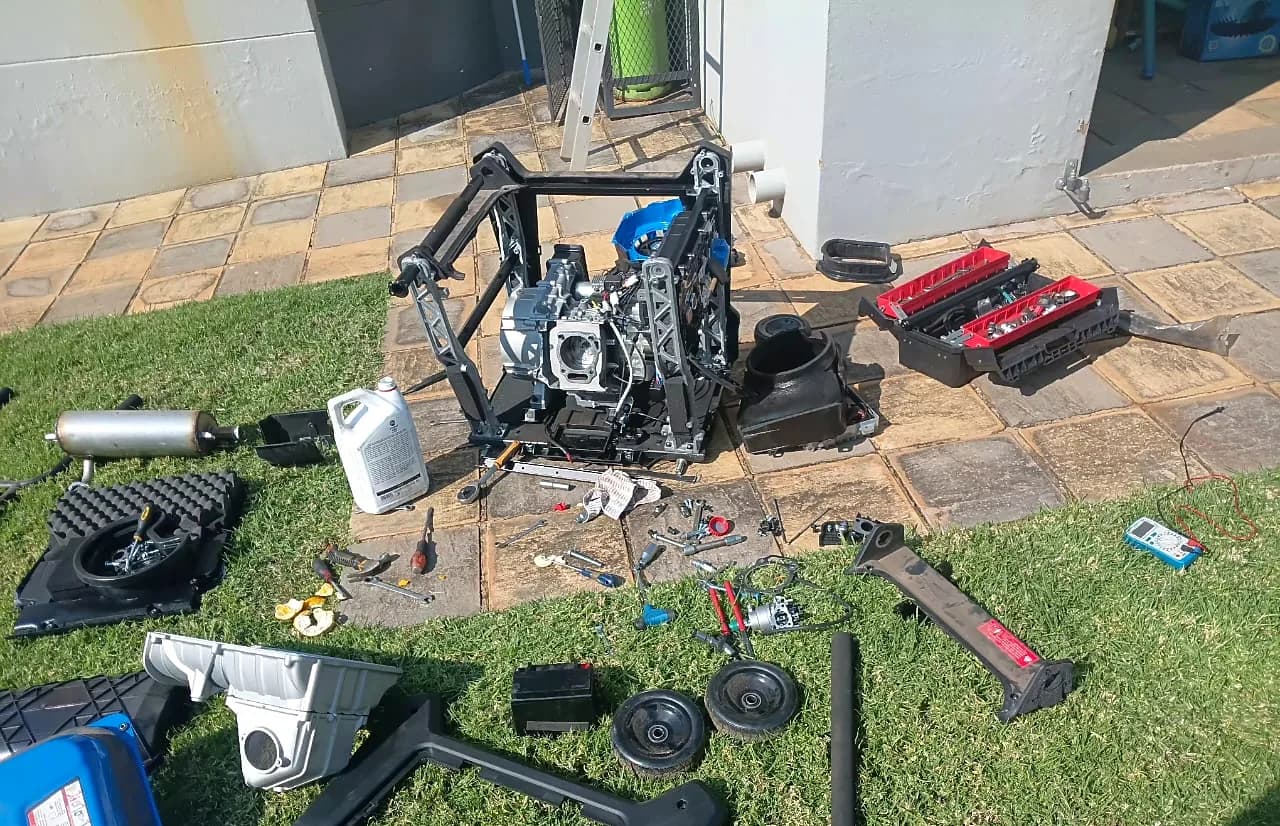
Portable generators work differently again. Honda petrol engines and inverter generators, and the many imported petrol brands sold in South Africa, mostly need carburettor, ignition, recoil-starter and inverter-module repairs, often after petrol has been left standing in the tank. Small air-cooled diesel portables have no carburettor or spark plugs, so their faults are in the injector, fuel supply and electric start instead. Our generator brands page has a guide to each make.
Repairs for every type of generator
- Diesel generatorsInjection, governors, cooling and alternators, from small silent sets to large standby plant.
- Petrol generatorsCarburettors, ignition and starting faults, often caused by fuel left standing.
- Gas generatorsLPG and natural gas sets: spark ignition, starting, engine, controller and alternator faults.
- Standby generatorsAutomatic sets with changeover panels that must start on their own when the mains fails.
- Portable and inverter generatorsSmall units for homes, sites and trips away, including inverter module and idle-control faults.
Service areas
Where we repair generators in Gauteng
Johannesburg: Johannesburg generator repairs
Standby sets in office blocks, hospitals and apartment buildings, silent sets behind homes, and shared generators in estates and complexes, from Midrand and Fourways to Soweto.
Pretoria and Centurion: Pretoria generator repairs
Generators for offices, government buildings, campuses and hospitals, homes in the eastern and northern suburbs, and the business parks of Centurion.
Ekurhuleni (East Rand): Ekurhuleni generator repairs
Factories, warehouses and logistics sites around O.R. Tambo and Isando, and homes and businesses from Kempton Park and Edenvale to Boksburg, Benoni and Springs.
West Rand: West Rand generator repairs
Krugersdorp and Randfontein, and the farms, smallholdings and venues towards Muldersdrift and Magaliesburg, where a generator often runs a borehole pump as well as the house.
Vaal Triangle: Vaal Triangle generator repairs
Steel and engineering plants in Vereeniging and Vanderbijlpark, and homes, resorts and smallholdings along the Vaal River and around Meyerton.
Repair or replace?
Most generator faults are worth repairing. Replacement starts to make sense when the engine itself is worn out, parts are no longer available, or the repair would cost a large share of a comparable new set.
We tell you which side of that line your generator is on before you spend money on it. Our repair cost guide explains what drives the price, and the repair or replace guide walks through the decision.
If a new set is the better answer, the kVA sizing guide shows how to size it for the loads you actually run, and our generator installation page covers the changeover and fitting.

FAQ
Frequently asked questions
How quickly can you get to me?
We arrive within 1–2 hours, usually within 1 hour, and we take calls 24/7 on 076 434 7292. If the generator has failed during an outage, the emergency generator repair page explains what to do while you wait.
Do you charge for the callout or the quotation?
No. Free callouts and quotations. We find the fault, explain it and quote, and no repair work starts until you approve the quotation.
Which generators and brands do you repair?
We Service & Repair All Generator Brands: diesel, petrol and gas generators, from portable and inverter units to large standby sets. Our capability covers 1 kVA–20,000 kVA.
What is the difference between a repair, a service and a maintenance plan?
A repair fixes a fault the generator has now. A service is a single planned visit that replaces the oil, filters and other wear items and checks the set over. A maintenance plan is the ongoing, agreed schedule of services, with inspections, test runs and changeover checks between them, that catches wear before it turns into a breakdown.
Why did my generator fail during load shedding when it worked last month?
Usually because outage duty has caught up with a part that was already weak. The starting battery and its charger are the most common causes, followed by changeover faults, fuel problems and services that have fallen behind the running hours. A battery test, the controller’s event log and a look at the fuel system normally show which.
Can every repair be done on site?
Fault finding and most repairs to the engine, fuel system, controls and wiring are done on site. Some work, such as alternator rewinding or a major engine overhaul, needs a workshop. If so, we explain why and quote before anything is moved.
Do your repairs come with a warranty?
Yes. One-year warranty. Ask us what it covers for your repair before you approve the quotation.
Should I keep running a generator that is smoking or overheating?
No. Running it can turn a small fault into a major one. Switch it off, let it cool and call us. The overheating and smoke guides explain what is safe to check yourself, and controller alarms explained shows what each kind of alarm means.
Related pages
Related generator problems
Related brands
Who we work for
Need a generator technician?
- 24/7 operations
- We Arrive Within 1–2 Hours (usually within 1 hour)
- Free callouts and quotations