
Guides · Owning a generator
How to Get Ready for a Generator Technician’s Visit
To prepare for a generator technician visit, send the make, model and kVA rating, the hour-meter reading and a photo of the controller screen, describe what the generator is doing, and arrange safe, clear access to the set and its changeover panel. With that, the technician can bring the likely parts, start work on arrival and, where possible, finish the repair or service in one visit.
Technical guide · Last reviewed 16 October 2026
Details to send before the technician sets off
| Detail | Where to find it | Why it helps |
|---|---|---|
| Make, model and kVA rating | Where to find itThe set nameplate on the canopy or base frame | Why it helpsShows the size and type of set, and which tools and test equipment to bring |
| Engine and alternator details | Where to find itData plates on the engine block or rocker cover, and on the alternator housing | Why it helpsParts are ordered by engine and alternator, not by the name on the canopy |
| Hour-meter reading | Where to find itThe controller screen or a separate meter on the panel | Why it helpsShows whether a service is due and how hard the set has worked |
| The alarm or status message | Where to find itThe controller screen, photographed before any reset | Why it helpsPoints to the system at fault, so the right test equipment comes along |
| Fuel type and level | Where to find itThe gauge, sight glass or tank | Why it helpsA set that is low on diesel, or has drawn air into its fuel system, behaves like one with a fault |
| What it powers | Where to find itYour own knowledge of the site | Why it helpsShows how critical the load is and whether an ATS is involved |
Not sure where the plates are? The diagram below shows the usual places, and a photo of the whole generator is a good start.

Describe what happened, in order
The order of events is often the best clue. “It started, ran for twenty minutes, then stopped with an alarm” points somewhere different from “it cranks but never fires” or “it runs, but the house stays dark”. Note when it began, what the generator was doing, and anything that happened just before: a storm, a fuel delivery, a long run during load shedding, or recent work on the electrics.
Mention sounds, smells and sights too: a bang, the colour of any smoke, a smell of diesel or hot metal, or a puddle under the set. If the fault comes and goes, say when, for example only when the borehole pump starts or on the first cold start of the day.
Our generator problems guides help you put the symptom into words, and say which checks are safe for you to make while you wait.
Photos that save a trip
Six photos worth sending
Set nameplate
On the canopy or base frame: the model, serial number, kVA rating and voltage.
Engine data plate
On the engine block or rocker cover: the engine model and number, which decide most parts.
Controller screen
The alarm or status message exactly as it appears, before anyone presses reset.
The whole generator
From a few steps back, showing the access and the space around it.
The changeover panel, closed
The front and its labels, without opening it: it shows whether changeover is automatic.
Anything that looks wrong
A leak, a burnt cable, smoke staining, a cracked hose or rodent damage.
Clear the space around the generator
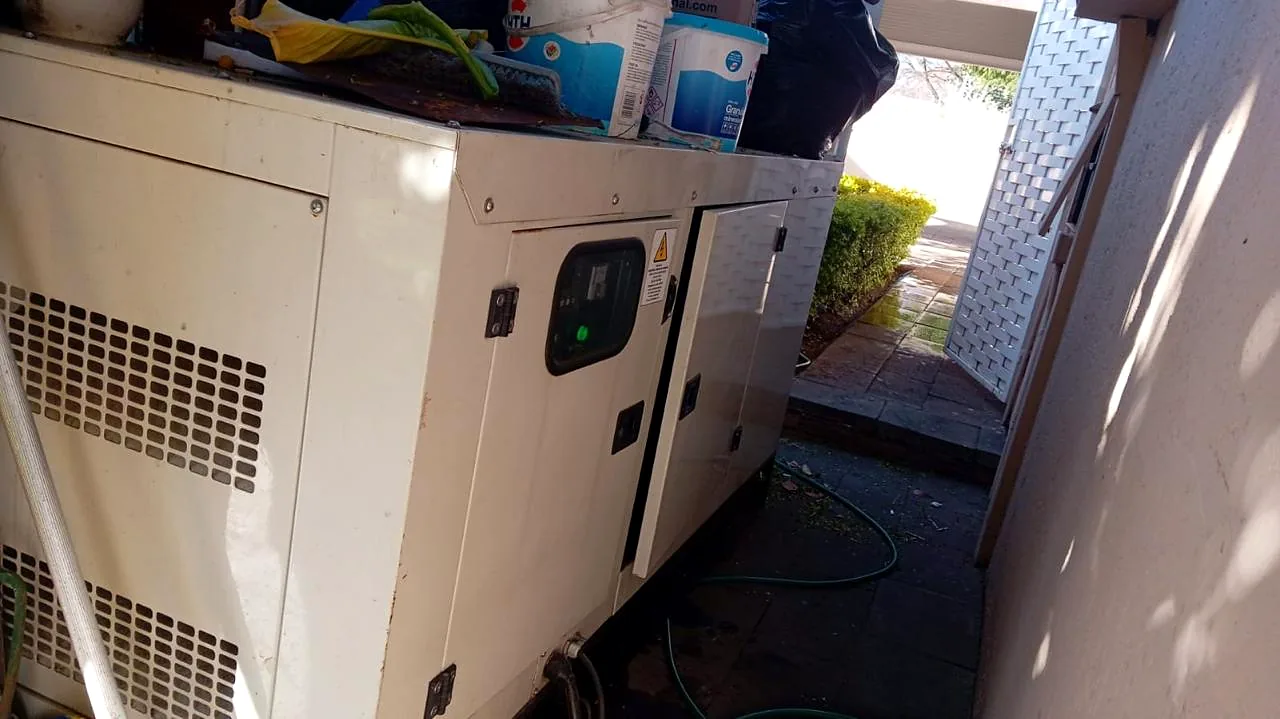
Generators often end up in narrow side passages, carports and garden corners, with garden furniture, bins or boxes stacked on the canopy. The technician needs to open the service doors on both sides, reach the battery and filters, and carry tools and parts from the vehicle, so clear a working space before the visit.
Cut back plants that cover the radiator grille or exhaust outlet, move vehicles out of a carport, and plan for light: an evening visit during load shedding may mean the yard lights are off.
- Nothing stored on or against the canopy
- Both service doors free to open
- Parking for a service vehicle close by
- A torch or work light for evening visits
Access, keys and permissions
| Arrange | Why |
|---|---|
| Keys to the canopy, the generator room and the room or DB board where the changeover panel is | WhySo every part of the system can be reached without waiting |
| Security estates and complexes: the technician’s details on the visitor list or access app, and the guardhouse told | WhySo the visit is not held up at the gate |
| Body corporate or managing agent informed, where estate rules limit working hours or noise | WhyA test run is loud, and some estates need notice |
| Businesses: site induction, permit to work and PPE rules, and a contact who can approve a quotation | WhySo commercial and industrial work can start on arrival |
| Farms and smallholdings: a location pin and directions from the nearest landmark | WhyGenerators on large properties can be hard to find |
| Dogs secured and children kept away from the work area | WhyFor everyone’s safety while panels are open and the engine is tested |
Planning the time
Load shedding and planned power interruptions
Some tests interrupt the mains. To prove an automatic changeover, the technician simulates a mains failure: the generator starts, takes the load, and hands it back when the mains returns, with a short break in supply at each transfer. Agree a time for that, warn the people in the building, and shut computers and servers down properly first. Gate motors, alarm panels and electric fences may need to be checked afterwards.
If the fault only shows when the power fails, such as a set that runs but never takes the load, booking the visit across a scheduled load-shedding slot lets the technician watch a real transfer. If you know when your next slot is, mention it when you book.
If the generator must keep a business running during the visit, say so: some repairs need the set stopped and isolated, so the timing is planned around that.
On the day
What happens when the technician arrives
- 01
History
The technician hears what happened and reads the controller’s alarm and event history.
- 02
Make safe
The set is isolated so it cannot start or feed the load while panels are open.
- 03
Diagnose
Tests on the engine, alternator, controls and changeover find the cause, not just the symptom.
- 04
Quote
You get a quotation for the repair before any work starts, and decide.
- 05
Repair and test
Once you accept it, the work is done and the set is tested, under load where the site allows.
- 06
Hand back
The generator is left in automatic and you are told what was found and what to watch.
Before the technician leaves
A minute at the end of the visit saves confusion at the next outage.
- Is the generator back in automatic mode, with no alarm showing?
- What was the cause, and what was replaced?
- Are any parts on order, and when will they arrive?
- Is there a separate quotation for further work?
- When is the next service due, by hours or by date?
For what a routine service should cover, see the generator service checklist.
FAQ
Frequently asked questions
Does the callout cost anything?
No. Free callouts and quotations. No work starts until you have approved the quotation.
Do I need to be there?
Someone should be available to give access and explain what happened. For businesses, a contact who can approve the quotation lets the repair go ahead the same day where possible.
Should I reset the alarm before the technician arrives?
Photograph the screen first. One reset is reasonable if the cause is obvious and fixed, such as an empty fuel tank that has been filled. If the same alarm comes back, leave it: repeated restarts can turn a small fault into engine damage.
Can you work in a security estate or office park?
Yes. Tell us how visitors are let in, whether the technician’s details are needed in advance, and any rules on working hours or noise.
What if the generator has failed during an outage?
Call us straight away; we take calls 24/7. See emergency generator repairs for the safe steps to take while you wait.
Related pages
Related services
Related generator problems
Who we work for
Need a generator technician?
- 24/7 operations
- We Arrive Within 1–2 Hours (usually within 1 hour)
- Free callouts and quotations